Monday, April 29, 2013

City of God: Cinematic Portrayal of Violence


"If this is His city, what Hell look like?"


"One wants to steal the loot; after all, the youth are only 'niggers and thieves'; the other wants simply to 'exterminate' the men. This dialogue, coupled with the image of the men huddled primitively in the tree branches, calls attention to the way in which they have been dehumanized by the state and by the discourse of the media"

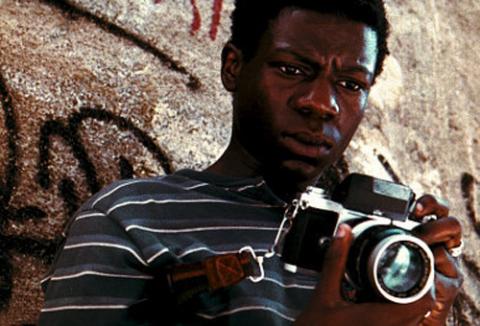
City of God is a film directed by Fernando Meirelles, and it depicts the troubled lives of those living in the Brazilian favelas, surrounded by gangs, drugs, and incessant violence. The portrayal of violence in City of God is shown through our narrator, Rocket, who is subject to this violence growing up in the favelas of Brazil. Rocket grows up to photograph the horrors of the violence of his city to bring it to the attention of the media. The narrative is very character driven, as Rocket narrates the actions and history of almost every key character in the film. This individual characterization allows the audience to witness the development of each character, building a connection or sympathy that leads the audience to either completely detest every action they make, or exemplify their deaths or tragic outcomes. However, through such intimate characterization, the film manages to completely dehumanize every action of the gang violence, referring to the horrors being carried out by "'niggers and thieves'". This is how Meirelles' directing effectively creates a complex narrative, as the audience starts out with a small personal issue of money and power between a few individuals, and it relates back to a larger scale act of gang violence and drug trade in Brazilian favelas.

"The favela is on one level a defined space with specific geography, straight rows of houses and repeated locations. On another level, it is a landscape with violent and incomprehensible qualities. In chase sequences, for example, camera angles are repeatedly reversed, confusing direction and space."

The cinematography of the film significantly adds to the chaos and discord resulting from the violence in this film. As stated above, the "camera angles are repeatedly reversed, confusing direction and space". It's camera movements like these that creates that sense of being lost in the favelas. The issue of the whole situation is almost "incomprehensible", especially to those affected by it. Rocket just accepts all the violence and chaos as he grew up with a brother who was a hood. The exposure to the violence is enough to force individuals to accept it.

“The audience sees bodies falling, or lying on the ground, but the editing is rapid and generally cuts immediately away. The audience doesn't see the blood or tearing of flesh that we assume must accompany events. “


The editing indeed contributes to this sort of dehumanizing violence. The lack of "blood or tearing flesh" is what signifies how the people affected by it accept this violence. It happens so commonly around them there is no need to observe and sympathize with the corpse of the unfortunate. One of the possibly few gruesome death scenes that were emotionally attached were the deaths in the brothel during "The Sixties". It was in this scene that the shot was held particularly long, in order to set the tone of the violence-intensive film that the audience would begin to delve into.


Wednesday, February 13, 2013

Psycho Commentary


Self-Evaluation

20/25

16–20 There is a coherent and detailed analytical evaluative interpretation of the extract, displaying
a good understanding of how meaning is constructed through the use of film language and a
good awareness of the extract’s relationship to the film as a whole. There is a clear
explanation for the selection of the extract. The critique shows a good awareness of the film’s
genre, its place in a broader sociocultural context, and gives a sound analysis of the director’s
intention. There may be brief elements of description but analysis will be thorough.

I gave myself a 20 because my commentary is coherent and somewhat detailed in the analytic perspective. I was able to interpret much of the meaning behind what was in my extract, from the cinematography, to the editing, and role in narrative structure. However I didn't necessarily go in-depth into the different aspects, as they related to director's purpose and intention. There is broad mentioning of sociocultural aspects in Psycho. I also related genre to the historical context of the film's place in time as well, as how Psycho transformed the idea of horror films.

Friday, February 1, 2013

Film Language and Representation

Film Language and Representation

(Only second half of my extract)

The extract I have chosen was the cleanup and hiding of Marion Crane's body and car, which took place after the notorious shower murder (starts at 55:00). The character being focused on in this scene is Norman Bates, as he disposes of Marion's body by storing it in her trunk along with her other belongings. Bates then drives the car to a nearby swamp and sinks it, thus hiding all evidence. This event finalized the end of Marion Crane and how the plot shifts full focus on Norman Bates.

Anthony Perkins' acting really sells the character of Norman Bates here. At this point in the film (having no prior knowledge) one would believe that Norman's mother is the murderer, and within the first two minutes he plays the role of innocent son defending his mother. The action in which he wraps the shower curtain is executed so cleanly, carefully, and professionally. Even around a minute in, he cautiously checks around as cars pass by, really portraying that innocent and shocked character. No one would have guessed that he's the psychotic antagonist behind this film all along. However, when he reaches the swamp, his character begins to gain that sinister tone behind him. The way he menacingly watches over the sinking car brings forward only dark undertones.

The cinematography of this scene really conveys the shift from innocence to morbidity within the plot of Psycho. With the body-wrapping scene, Hitchcock hides the body itself from our view as it's being wrapped in the shower curtain. If we were to have seen the body, the film would be too gruesome and would be a bit too gruesome too early. However as we reach the swamp again, right after the car is shown sinking, it cuts to a close-up of Norman Bates' sinister face looking down upon the lost evidence. The low angle close-up gives the audience a sense of power within Norman Bates, as he makes the car (and Marion) seem inferior to him. 
The editing supports each theme being represented, as pacing and shot selection can be potential factors altering how these themes are conveyed. For example, we see that Tomasini (editor) liked to switch between the shot of Norman's face looking down on the swamp and the car sinking. This constant switch made the scene a little uneasy, as it kept cutting to a previous shot, and as viewers, have to watch the car completely sink (which i'm sure stops at one point then continues).

The lighting within this extract was very powerful in its use of cast shadows seen on Norman's face as he looks upon the car. These shadows drag across half of his face, which conveys a dark, mysterious look. The mystery behind his character pretty much sets up the anticipation for the rest of the film, as we lean toward Bates being the murderer, rather than his mother.

Great orchestral work was performed all throughout Psycho, even in these minor 5 minutes. To reinforce the eerie, mysterious theme of the cleanup, it was perfect timing in which the bass cello came in. However as he picks up the shower curtain and places Marion in the trunk, the music goes silent. All that is heard is the ruffling of the shower curtain in which Marion is wrapped in. The isolation of the shower curtain noise evokes  
an unsettling scene, in which the audience tends to only imagine the horror of the corpse that lays in the curtain. The sharp violins re-accompany the bass as Bates loads up the trunk with Marion's belongings. These noises are only a bit soft at this point, however completely goes silent as he's sinking the car. This also unsettles the audience and causes more attention to the expressions of Bates as the car goes down.


One setting of this extract that is worth mentioning is that of the swamp. When the car begins to sink, the setup of this shot has elements in the foreground, middleground, and background. The openness of the elements in the shot guide our eyes toward the middle, where the car is placed.

The emotional information conveyed gives the audience a sort of glimpse into the mind of Norman Bates. Knowing of Marion Crane's past, and contrasting it with the initial innocence we see with Norman, there is almost a form of sympathy for Norman. I know personally that I didn't feel any remorse for Marion as that car slowly sank to the bottom of the swamp. The mood of this scene is very pivotal to the plot, as Hitchcock slowly transitions the plot focus onto Norman through this scene. 

Wednesday, January 30, 2013

Psycho: Socio-Cultural Context


Psycho: Socio-Cultural Context


Alfred Hitchcock's Psycho represents the culture of 20th century America. This film serves more as a representation of the progression of cinema as of the 20th century. The new innovations of this era of film included the introduction to sound and even color films. However with these new innovations came repercussions, seen through issues against censorship. Hitchcock daringly fought against these standards through his use of women's lingerie and even using the first American film scene including a flushing toilet. These actions were very bold at the time, causing quite a shock to the initial audience. However, Hitchcock couldn't beat them all, and chose to do the film in black and white for two reasons. One, the budget was aimed to be under $1 million (turned out to cost $800,000), and two, he made the directorial choice because he believed that Psycho in color would be too gory for American cinema at the time.


Hitchcock was a London-born filmmaker, moved to America. "Relying heavily on what he thought of as his intimate knowledge of the British countryside, cityscape, and audience and character psychology, he nevertheless described himself, with great pride, as an American-trained cinematic artist, brought up on the style and production methods of American filmmaking." Hitchcock declares himself as an American filmmaker, although he could be declared a pioneer in stretching the standards for American cinema, with his knowledge of British filmmaking.

Hitchcock's Psycho was seen as an important forerunner to the "slasher" sub-genre of horror. The film's knife-wielding and mentally disturbed killer, twist ending and 'stalking' camera technique proved influential on films to come.

Monday, January 28, 2013

Psycho: Narrative and the Film Extract


Psycho: Narrative and the Film Extract


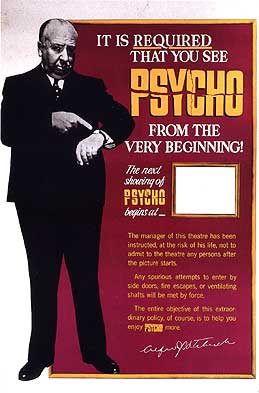
On release, Hitchcock himself sparked an interesting advertising campaign claiming that Psycho could only be seen from the very beginning of the film.
"We won’t allow you to cheat yourself. You must see PSYCHO from the very beginning. Therefore, do not expect to be admitted into the theatre after the start of each performance of the picture. We say no one — and we mean no one — not even the manager’s brother, the President of the United States, or the Queen of England (God bless her)!"
It's obvious this was to preserve the authenticity of the film's convoluted plot structure. Also it highlights Hitchcock's ability to manipulate the minds of the audience through narrative. The film is constructed in some odd 2-part/3-part narrative. The reason I say this is that Hitchcock purposely sets the beginning of the narrative as setup following Marion Crane. The audience is led to believe that the film would follow Ms. Crane and her trying to escape with the money, our MacGuffin at the moment. Her character is played so well that it is believed that Ms. Crane would be the "Psycho". Up until the pivotal shower scene, is when the plot takes a drastic turn. Ms. Crane being missing becomes the new MacGuffin that propels the plot. Over the course of this act structure we see developing traits in Norman Bates as we follow the string of murders.

The narrative is propelled by plot as each event has a cause-and-effect sequence to it. For example, after the private eye is killed, the curiosity and worry of Ms. Crane's boyfriend and sister cause them to head to the sheriff and later on the motel itself. The MacGuffin also propels the story as we follow the money as it leads to the downfall of Marion Crane. 

Sunday, January 27, 2013

Psycho: Historical and Institutional Influences


Historical and Institutional Influences in...
Alfred Hitchcock's Psycho

Alfred Hitchcock "did not merely work within a medium but utterly transformed it." Hitchcock is definitely an  important figure on the evolution of cinema, and there were certain factors that led him to be the auteur we recognize him as. 


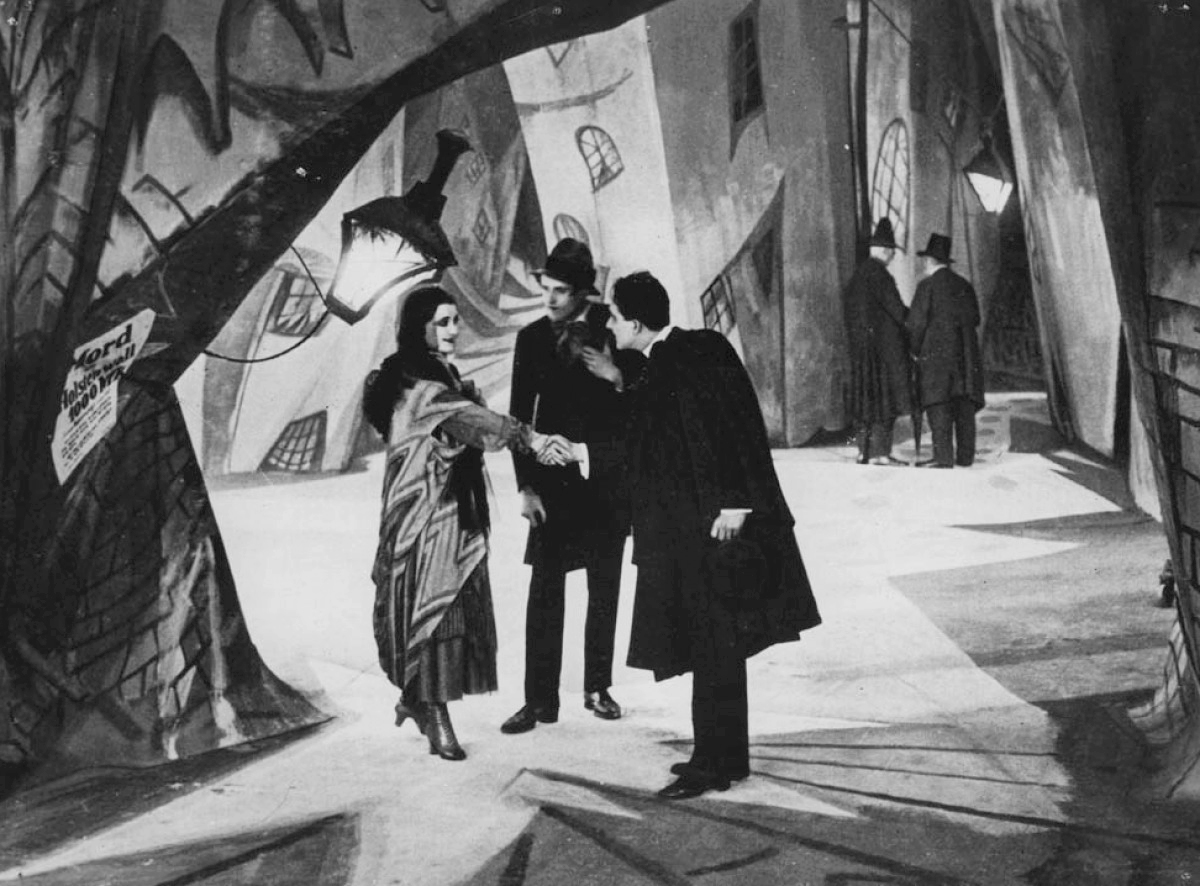
For one, early in Hitchcock's exposure to cinema, he developed a fancy towards German expressionism on a trip to Germany. As a producer, Hitchcock has developed and adapted German expressionism into his films such as in The Lodger (1972) with the "fascination with heightened emotional states, the imaginative coordination of set design and camerawork, and an almost musical rhythm to the sequence of shots". A second institutional factor rising during the time of Hitchcock's films was the development of sound in cinema. Hitchcock himself despised using dialogue as a safety-net for producing "good films". "He was not adverse to witty dialogue—his scripts were always remarkably literate—but the dialogue itself served as an accompaniment to visual storytelling and not as a substitution for it."

Hitchcock's Psycho was an accurate depiction of time in the 1950s - early 60s. Although the film's plot was unoriginal (as it was based off of Robert Bloch's novel of the same name), it was based off of the story of Ed Gein from Wisconsin. Psycho also broke all film conventions by displaying Marion having a lunchtime affair in her sexy white undergarments in the first scene and killing her a third of the way into the film. Hitchcock also began terming the plot device known as the 'MacGuffin', the thing or device that motivates the characters, or propels the plot and action. As it's used in Psycho, the MacGuffin would be either the sum of $40,000 stolen by Marion, or further on in the film, the murder of Ms. Crane herself. 

Wednesday, January 16, 2013

Psycho: Genre and Audience


Alfred Hitchcock's famous Psycho (1960) was a great representation of the film's genre and Hitchcock's style. Psycho was Hitchcock's suspense/horror creation, further noted as a potential psychological thriller. Evidence of this sub-genre exists within the presence of a mentally unstable main character. The abundance of shadows and darkness within the scenes portray a heavy horror theme throughout the film. This low lighting creates fear and anxiety within the viewer. As someone once said, "What we fear most is the unknown"


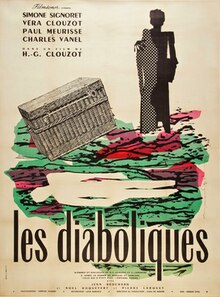
Other works that influenced or connected to Hitchcock's Psycho could include Les Diaboliques (1955) This was another suspense thriller movie that was initially offered to Hitchcock, but ended up in the hands of Henri-Georges Clouzot. It's basically the story of an abused wife who kills her husband, only to be haunted by his reincarnation. This psychological thriller seemed to have many aspects that were incorporated into Hitchcock's Psycho. Hitchcock even decided to shoot the film in black and white, not only to maintain his own self-sufficient budget, but also seen as homage to other pre-Psycho thriller films such as Les Diaboliques, The Night of the Hunter, and Touch of Evil


Hitchcock was the director of this film. However, although Hitchcock was signed with Paramount Studios, Paramount didn't like anything about the story and said that the novel was "too repulsive" and "impossible for films". Hitchcock resorted to funding the movie through his own "Shamley Productions". Hitchcock made this because his previous production was scrapped due to a main actress having to take a maternity leave.