Monday, January 23, 2012

Ideology in Film


What is ideology and how can it be implicit vs. explicit?

Ideology is a term that refers to the messages and values that a piece of media tries to communicate to the viewer. Explicit ideology is the definite message that a director/producer/writer demands to be communicated to the audience. Implicit ideology is a looser, and more debatable form of ideology. It's an ideology that can be gathered through analysis and argument.


Ideology and Expectations;Give an example of an a actor that presents a predictable ideological package that studios are quick to use. List as many of their film roles as possible – noting the particular actions/dialogues associated with the character that they play. Make a list of the five adjectives that you think best capture their typical role. Produce a detailed description of what you think their next role will be like.

Charlton Heston
Ben Hur - Ben Hur
The Ten Commandments - Moses
Antony and Cleopatra - Mark Antony
Leading, Adventurous, Courageous, Honorable, Influential
If he were to star in one more movie, he would probably play a mature man. He would be a typical role model, and possibly support the ideology of doing more for others than yourself

Personal Ideologies and the Enjoyment of Film: Think of a film that you enjoy and know well. Consider which characters you like. Analyze your favorite character using these useful questions to bear in mind when considering ideology are:
  • What is it that you like about them and what has the filmmaker done to encourage you to feel this way? 
  • What values am I being asked to share or reject? 
  • How are my feelings being manipulated to prefer one viewpoint over another? (Camera placement/movement and editing are particularly important here.) 
  • Why might a filmmaker want me to prefer one viewpoint to another? 
  • What are the artistic/financial consequences of filmmakers trying to predict what an audience might approve/disapprove of? 
  • What are the artistic/financial consequences of filmmakers trying to predict what a film's financier might approve/disapprove of?
Boondock Saints - Connor MacManus (Sean Patrick Flanery)

Connor and his brother were motivated to 'clean up the city' of all the silly mafia gang scum. I admire how they stick up for their morals and values even after given so much power and recognition. When making a hit , they stick with their Irish traditions, place pennies on the eyes of the dead, recite their family prayer, and pay their respects by visiting church afterwards. Debatable values of his actions include, family pride and value of friendship. Editing techniques help manipulate my viewpoint in certain cases. The editor uses slow paced shots when a value is being conflicted or reinforced. For example, during the battle scenes it's mainly fast match-action cuts/montage, but when that's over and they pay respects, the pacing slows down.

Changing Ideologies: Why would the ideologies of a given era or time period change the way a narrative is presented to its audience? Can you give an example of a film narrative that has changed over generations?


Ideologies change in accordance to society of the time. Depending on what the audience wants to see, what they will interpret and learn from the film will change. When ideology changes, interpretation of certain films will change. For example, in southeastern Asia, certain films had censored their government and military involvement in their own countries and other countries in their films. Over time, these governments soon grew to become a topic of interest for some films.


Ideology and the "Effects" Debate: Do you feel that films can affect you and your behavior without being conscience of it? 

Widespread and common ideologies can subliminally affect our own behavior and beliefs. Films tend to show the general content of examples when pertaining to a common ideology. For example, one can relate to a certain film when they themselves have been put in a similar situation. Films can help determine our perspective of 'common sense' and our ability to 'know right from wrong' by depicting these situations and having our protagonists values nobly reflect what should be done.

Ideology and Realism:Define Suspension of disbelief and give an example from a recent film you have watched.

Suspension of disbelief is a term used to explain how an audience accepts certain aspects of cinema that seem to go against reality. Ideology plays a role in this by determining whether breaking reality is acceptable when portraying a certain ideologies. For example, in science fiction films, there is normally very little knowledge on whether half of the scenes we see would be possible in the real world. The reason people don't critique the possibilities is because the film has to stay within the rules for films of the sci-fi genre. Like in Star Trek, Star Wars, and other space films, intergalactic travel isn't highly likely around our day and age. This is also covered by having these films set tons of years into the future, allowing imaginations to roam and explore the possibilities of the future.

Ideology & ownership: Does the financial support of a film or the ownership of a production company influence the ideology represented in a film? Explain with an example.

Financial support does give a movie its potential. High budget movies are expected to be 'the next big thing' out of cinema, or at the very least please their audience. However, spreading ideology is determined by the company itself providing the funding. Becoming well known and having more popularity would mean portraying the ideology behind their film with great success. So funding can cause bias in which way the ideology leans toward. For example, if one's going to advertise their film so widely and successfully, they'd want many audiences to accept it. For it to be accepted, it must appeal to the majority of audiences to gain the most money. Say if a low funded film is shot with an uncommon or opposite ideology than the norm, then it would see very little success in Hollywood cinema unless the film style is nothing short of revolutionary.

Tuesday, January 17, 2012

Genre

Action/Adventure


Mission Impossible

Indiana Jones

Fight Club


An action adventure film is essentially one long quest with a succession of different chase sequences, each one more death defying and seemingly impossible than the one before. The trick for the producers is to increase tension as the film progresses to a storming end sequence. Will our intrepid explorers make it, or will the evil antagonist get there first.

Typical Plot: The plot of an action/adventure movie would be the typical 3-act structure. We are presented with our main character and s/he comes across something that throws life into disequilibrium. They feel a need to set things right again, so they set out on a quest to do just that. The movie would normally end with the character performing a feat which would amaze and possibly save a part of humanity.
Typical Characters: Both male and female characters have been favorites of action/adventure movies. One would watch in awe of how a male character would fight against his enemies, while one would also be amazed at how well a female character could kick ass.
Typical Dress: Depending on the film, the outfits of the characters could range from standard house clothing, to fully decked-out military combat gear. When given standard clothing, the clothes could tend to rip, receive blood splatter, or show other signs of damage to make the character seem epic, or symbolize how they've changed from a citizen to an action hero.
Typical Dialogue: The action hero would engage in little dialogue unless it pertained to getting information to push them forward on their mission. Some characters would even take a "shoot first, ask later" policy.
Typical Objects or Equipment: The character is often given some sort of weapon or weaponry in aiding them on their quest. This could range from low-tech to high-tech weaponry. Some would be given a simple sword, compared to a full military arsenal.

War
Saving Private Ryan

Black Hawk Down
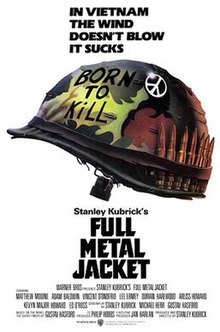
Full Metal Jacket
Narrative conventions of a war movie include being able to associate the soldier with their weapon proficiency (e.g. the sniper, heavy machine gunner, explosives expert) which allows us to easily identify them . There is also that key ethnic stereotype character in the team which the audience could easily identify. There is also the last-minute miracle of reinforcements to pull the heroes out of hell and push back the enemy.

Typical Plot: The movie would normally open up with a battle scene on the war front, then sometime afterwards, we would see what would be happening back at home and take us away from the fight. With this trip back, we would begin to understand a bit more of the plot centering around the troop we will be focusing on in the movie.
Typical Characters: Most often, war films would have males as their main character, considering that the film was based off a real historical war. Back then, it wasn't common to see a woman out on the battlegrounds of war, so war films tend to keep that standard when it comes to previous wars. When coming to modern wars or smaller scale non-militaristic wars, there could possibly be some women in the battles.
Typical Historical Setting: Most war films focused around the two World Wars, or smaller scale historical wars like civil wars or proxy wars. Some war films take place in modern times as well, such as a few in Afghanistan.
Typical Look or Style: War films tend to use gritty, shaky cameras when on the war front. Lighting may be dark and grim, or light and uplifting, depending on the mood of the event (i.e. if the battle is either going well or poor).


Horror
Scream
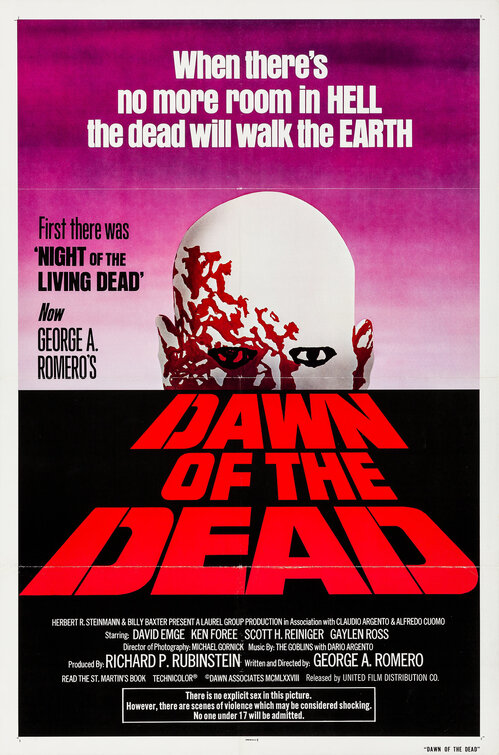
Dawn of the Dead
Haunting In Connecticut
Horror films tend to open with a murder scene of characters irrelevant to the story, or a character that the audience has no care for. This is mainly to help characterize the villain, and what they're capable of and how  they go about taking lives.

Typical Plot: The antagonist of the film tends to be characterized before our protagonist. After their situation has been established, the protagonist tries to survive, or possibly eliminate the antagonist.
Typical Characters: In Horror films, there is often a group of people subject to be victims of the antagonists attacks. Within these groups, females tend to be more feminine and helpless compared to normal women of today. 

Wednesday, January 11, 2012

Writing About Film - Response

1. What are the 5 kinds of film writing described in the article and what are the key details of each?


 In this article, 5 different types of film writing are described. Formal Analysis is a form of film writing where the writer analyzes different components of the film and how they come together and create a central idea or contribute to the film as a whole. Film History writing focuses on the history of a film and its influence on and from history itself. Ideological Papers analyze films that pertain to a central belief or set of beliefs, and how the film goes about portraying these messages. Cultural Studies/National Cinemas discuss the differences between the films of a different culture and how certain trends represent or portray their country or culture in film. Discussion of the Auteur criticizes the ability of how a single person (most often the director) can incorporate his/her own unique vision into a film and cause the finished product to be recognized as a film of a certain auteur's perspective.

2. What does “Annotating a Film Sequence” involve and what are it’s benefits?


Annotating a Film Sequence is when one takes a certain scene from a film and breaks down its components and identify the effect of each component of the film. It also helps explain how each effect contributes to the film as a whole. One would start by taking the scene and labeling each individual shot. Labeling each shot helps keep track of the complex shot sequences, and when reviewed, will uncover possible patterns or certain editing decisions.

3. What does the author imply when she says to “Think Beyond the Frame?”

To "Think Beyond the Frame" is not to think solely about the film, but instead, about what happens behind the scenes and notice the effort and reason into placing certain content within the film to make it its own. Identifying the director and noticing patterns or trends in his work can contribute to a nice film writing assignment. Production history of the film can help one realize what potential a film has given its certain conditions (budget, casting, writing, etc.) If one reads what critics and scholars have to say about the film, it will become easier to make observations because one could narrow down their observation around what the critics or scholars have appreciated or disliked. A film's genre plays a role in helping one identify limitations of the genre, and how certain filmmakers decide to enforce, or stretch these limitations. Lastly, cultural phenomenon can be seen in certain films which helps add to a message or thesis one might have in a piece of film writing.

Sunday, December 18, 2011

The American Anti-Hero


Several historical factors influenced the rise of  the American Anti-Hero in cinema. After the end of World War II, America felt a need for a new type of hero. From this, the birth of the Anti-Hero had begun. For one, America wanted to see new kinds of heroes to represent the new, post-war America. They also wanted heroes to rebel, as if the American public themselves were rebelling. America also wanted human heroes, people that have faulty qualities because they are human, like the real heroes of America. Lastly, America wanted a hero to represent true American spirit, whether it be good, bad, or ugly.

First, America felt that after they had won World War II, they had become a new, restored country. They felt that they needed a new type of hero to represent that. After being a part of a new World War and the Cold War, America was put in  a state of paranoia, or unsettling. The reason that the Anti-Hero succeeded during these times was because "'People were relating to the hip non-hero who was not involved in world problems but devoting his time to overcoming his own personal problems'" This characteristic allowed this new kind of hero to be accepted in America and Hollywood films.

America was also becoming more rebellious. After enduring two wars, they were left with almost nothing, and weren't going to take anything from anybody. Advocating people's rights and freedom were related to by many Americans. Relating to this group of people meant that they would stress a stronger relation to the anti-hero who exerted being an individual more than any other.

Also, Americans wanted a human hero, with his flaws and capability of being an ordinary man, like anyone in the audience. The perfect and charming hero began to lose favor among Americans. Instead, they wanted someone like them, able to accomplish great tasks using their own human strength. Having an anti-hero like this would allow the audience to find the motivation to believe that they can achieve such great tasks as well. "The anti-hero is rarely happy in situations that please other men. He prefers conflict and struggle rather than comfort and certainty.” This contrasts the standard perfect hero, who would give everything of himself for the sake of others.

America wanted to have heroes that represent the spirit of America itself. "The anti-hero became a darker, edgier character, who was just as confused as the average American" The average American could easily relate to the Anti-Hero because of his edgy quality, which represented the spirit of America for "the country went askew from what was once a politically and dogmatically ironclad identity."

Intensified Continuity

The term of intensified continuity is the description of traditional continuity amped up and raised to a higher-pitch of emphasis.  Elements of intensified continuity vary greatly from traditional continuity. Bordwell suggests that continuity has intensified in Hollywood cinema because of technological innovations in film making. Techniques and innovations that lead to the creation of intensified continuity include changes in shot length, varying lens length, and framing and cinematography techniques.

Bordwell is saying that over the years, American films have begun to develop faster paces of editing in their films, compared to traditional films from the 1930's to 1960's. Back then, the average shot lengths of Hollywood feature were around 8-11 seconds. One would be commended for maintaining an ASL of 6 seconds or less. In modern Hollywood films however, films have hit up to 3000 shots and the ASL's have gotten surprisingly low. Some films averaged around a 2 second ASL. Bordwell asks, "Has rapid cutting therefore led to a 'post-classical' breakdown of spatial continuity?" This question suggests whether the rapid cutting can keep the viewer contained and understanding throughout the film. This can be true in some cases, where action sequences get cut too fast and one loses coherence. However, many film directors nowadays have adapted and developed spatially coherent forms of capturing fast-paced action sequences.

Traditional film makers would take a lens length they would deem suitable to rely on for certain shots of their movie. For example, if a traditional film maker wanted to rely heavily on close ups and long distance shots, they would choose a 100mm-500mm lens for the entire film. They would use shorter lenses if they wished to capture wide or full shots. What intensified Hollywood films' concept of continuity was how directors decided to "freely mix long-focus and wide-angle within a single film." Directors that adapted this technique pushed the limits of relying on only certain shots to create successful films. They adapted all types of shots incorporated with their varying lens sizes.

The third element highlighting the change to intensified continuity is the use of close framing in dialogue scenes. In traditional films, an actor was hired for their entire body. Close ups were frowned upon, for the audience believed they payed to see an entire person, not a part of them. Directors later realized that the full body shots didn't entirely capture the audience. This introduced the creation of medium-shots and close-ups. Bordwell stated “If a scene relies on rapidly cut singles, the filmmaker must find fresh ways to emphasize certain lines or facial reactions.” The use of long shots versus close ups depends on the director's perspective, but the simple fact that Hollywood has learned to accept both styles of filming supports the acceptance of intensified continuity in American mass-audience films today.

Wednesday, December 14, 2011

Advanced Editing Notes: 3. Soviet Montage and 4. Realism

3a. Pudovkin's concept of constructive editing was that each shot should have a new intention on purpose and point. He believed that juxtaposition of shots could form meaning between two shots. The individual shots themselves were not as constructive towards the meaning of the scene itself. He used close ups in a unified order to also help create meaning. Long shots were too close to reality, and montages of close ups, textures, symbols, and other selected details were most effective in expressing the film's idea.

3b. The Kuleshov effect shows that juxtapositions create emotion, not the performance of the actor themselves. He believed ideas are created by linking fragmentary ideas to make a fluid action. These ideas don't even have to be related in life. An example of this can be seen in Spielberg's movie, Schindler's List.   This film had been shot in black and white, but Spielberg intentionally colors a little girl dressed in red to be able to be spotted out in the midst of all the action of clearing the Jewish ghettos. We close in on the little girl and see her being carefree and skipping everywhere to symbolize innocence. However, the shots that follow consist of gruesome and horrid scenes. With this contrasting juxtaposition, an idea of sympathy or sorrow is heavily created. However, this example leans a bit more towards Eisenstein, who developed the Kuleshov effect into context within the scene.


3c.  Eisensteinian montage is an adaptation of the Kuleshov effect explained earlier. Eisenstein had taken this effect, and used it within elements of a scene, rather than shots unrelated in life. Eisenstein heavily believed life was about constant change and contrasting opposites. In Odessa Steps, the Eisensteinian montage was evident when we see a child falling down the steps as the army's advancing and taking innocent lives. 

4a. Bazin believed that what attracted an audience the most was the direct relationship of realism. His opinion was that editing and unorganized shots caused a scene to lose its effectiveness. Film could be much more simplistic and effective without editing and montages. Montages were only one of many techniques that filmmakers had at their disposal.

4b.  Realist filmmakers strive for a sense of simplicity, and disinterest in a forced approach to an idea. Instead, audiences are expected to gather their own opinion and form an idea based of what they are given within a scene. They believed the essence of reality relied in ambiguity, allowing the audience to develop an idea of their own.

4c. Realist filmmakers do not believe in juxtaposing shots, montages, or heavy editing. Instead, they make use of other techniques, such as, long shots, wide screen, lengthy takes, deep focus, panning, craning, tilting, or tracking. They did not cut to individual shots, for they believed this was too direct of an action to allow the audience to develop their own idea. Cutting was a technique more manipulative of the audience to force an idea into their heads.

Monday, December 12, 2011

Advanced Editing Notes- Overview/Classical Paradigm


1. There is varied camera work between the two pieces, "Arrival of a Train" and "Damsel in Distress". The "Arrival of a Train" is one long sequence shot, with practically no cuts or other shots at all. The camera is in place the entire film, not moving or panning or making any other camera movement. In "Damsel of Distress" however, the concept of camera angles are much more evident. This film utilizes different camera angles and perspectives. These help us develop ideas contributing to the narrative purpose of the film. For example, we look down on the damsel from a higher perspective to show her feeling of hopelessness and distress. However, when she realizes she can call her dog for help, we go into a close up to show delight and hope on her face.


2.  "Arrival of a Train" is heavy evidence of the realism editing style. This is a prolonged sequence edit, and all events happen within the scene. There is practically no real editing here. "Damsel in Distress" leans toward the classical editing style, with its use of cuts and parallel action. In "Damsel in Distress", for one, there are multiple shots that have been edited together. We'll be watching as the villain ties up the woman then hides behind a tree, then we cut to the tree to see his dastardly evil grin. This highlights the classical editing style by using selective shots and close ups to allow us to interpret the message that the filmmaker wants us to understand, rather than giving us a wide shot and allowing us to interpret our own message.

3. The story and narrative characteristics are both pretty straight forward. "Arrival of a Train" is practically one prolonged shot, giving a simple story, or telling of event. One can obviously infer that the train is arriving, and people begin to board and disembark. However, there is no real plot, like what "Damsel in Distress" offers. We are presented with a 3-act story, and with the help of parallel action, the story is told clearly and interpreted easily. Classical editing takes place here with the incorporation of parallel action to help tell a story. We see a girl chained to the train tracks, and then it cuts to a shot of the moving train. It's obvious to the viewer that the woman is about to be run over by the train, and she needs to call for help. From there, it's  evident that one can determine the courses of rising action, climax, and resolution. She whistles for her dog who calls for help, the dog goes to the train and signals for the break, the train stops, and the dog finds the criminal hiding in a tree.